



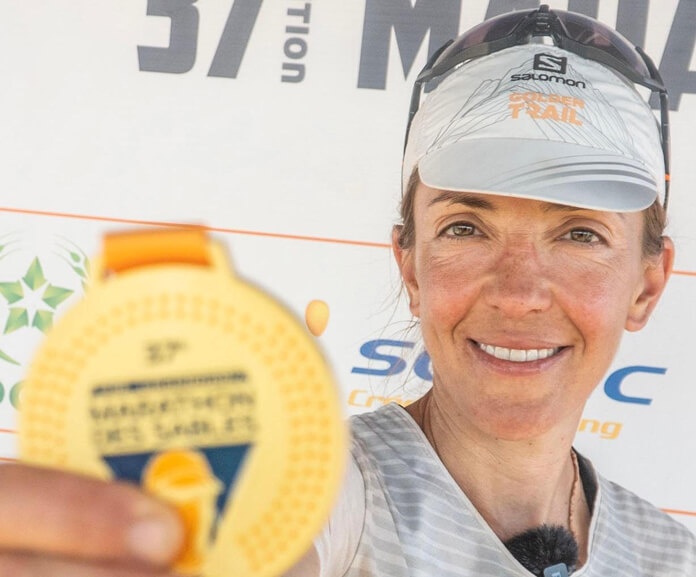
Few Portuguese athletes manage to combine elite sporting performance, a spirit of adventure, and such a deep connection with the mountains as Ester Alves. With a journey that began in competitive rowing and later moved through cycling before reaching trail running, Ester has built a career marked by endurance, resilience, and a constant search for her own limits.
In this interview with Correr Por Prazer, Ester Alves talks about the path that led her to the world of ultra trail running, the toughest moments she has faced in competition, her relationship with the mountains, and the motivation that continues to drive her toward new challenges.
Ester Alves is now a reference in ultra trail and high mountain races. How did this journey begin, and when did you realize this would be your world?
I have always practiced sports. I started in rowing, a discipline in which I represented Portugal at World Cups and World Championships. I was part of the Olympic project for Beijing 2008, and it was after that Olympic cycle that I began my journey in cycling. I competed in several national races and, thanks to the motivation and discipline I brought from rowing, I quickly started reaching podium positions. When I won the national title, I was invited to join a Basque team and compete in Spain.
I stayed there for four years until I was accepted into the PhD program at the faculty where I most wanted to study: FMUP.
It was then, after returning to Portugal, that my great friend Pedro Amorim introduced me to trail running and to the person I consider one of the greatest teachers in the sport: Carlos Sá. That was when my real trail running journey began. In 2015, I achieved 8th place in the World Trail Circuit and also 8th place in the 170 km UTMB, a result that led Salomon to invite me to join the team. I was several times national champion in trail and skyrunning.
Your career is strongly connected to long, technical, and self-supported races. What attracts you to these more extreme challenges?
Later on, beyond long-distance races, I also decided to participate in extreme stage races. My main goal was to test limits and better understand human physiology — an area that has always fascinated me academically.
Even today, I remain connected to projects with ICBAS and FMUP, studying human physiology applied to exercise and running.
Is there a race or expedition that you consider a turning point in your career?
The great turning point in trail running was undoubtedly my 8th place at UTMB, at a time when some of the strongest names in the sport were already competing, such as my biggest reference, Nuria Picas.
That year I completed the 170 km race in 28h48m, setting the best-ever result by a Portuguese female athlete at UTMB — something that still surprises me today.
You have competed and explored very different environments – Europe, mountains, altitude, and adverse conditions. What was the toughest environment you have ever faced?
The two toughest scenarios in which I truly realized things could go badly were:
The first was at the Marathon des Sables, in a year when we raced in temperatures reaching 54ºC. During the long stage, I lost consciousness for about 20 minutes, according to what I was told. I collapsed on the sand and was awakened by athletes and members of the organization. I remember waking up to the sound of a helicopter above me. I was severely dehydrated and they asked if I wanted to continue. I decided to keep racing, even realizing that something serious could happen. That year, two people died during the competition.

The second moment happened in the Himalayas during the Everest Trail Race. In one of the final stages in 2017, we faced temperatures of -13ºC. I spent the entire night awake, constantly moving my body to stay warm. The loss of body heat and fatigue caused several moments of mental confusion the next day. I remember stumbling and falling countless times. Even so, with analytical thinking and a fighting spirit, I managed to finish on the podium.
What is the most demanding aspect of this kind of race for you: the physical side, the mental side, or dealing with solitude for so many hours?
Without a doubt, the physical component is the most demanding. We need to be extremely well prepared to endure all the extreme discomfort associated with these races. Mental breakdowns often happen when the body is not prepared for the effort.
As for solitude, it has never bothered me. Many athletes, like me, are drawn to long distances precisely because of the personal growth and introspection they provide.
In high mountain races, conditions change constantly. When did you feel most vulnerable during a race?
I never truly felt vulnerable during a race, even in storms, because we always know there is an organization and rescue teams prepared to intervene.
However, during a mountain training course in the Picos de Europa, while the group was progressing slowly with ropes, there was a rockslide and falling snow blocks. Remaining calm, and with snow up to our knees, we had to help reassure people who were panicking.
In the mountains, we must always respect progression, act responsibly, and remain calm under any circumstance. I learned a great deal during that week and grew enormously as both an athlete and a person.
I believe that every amateur trail athlete should experience mountain progression training before attempting races above 3,000 meters.
Was there ever a moment when you thought about giving up… but kept going? What made you continue?
There were many moments. I have also abandoned races before — and that is a sign that I have competed in many events. Fortunately, my success rate has always been much higher than my withdrawals.
“Giving up should never be a reason for shame.”
I particularly remember the Ultra Skyrunning World Championship at Buff Epic Trail in the Pyrenees. That year, we faced extremely severe storms during the race. There were moments when the cold was so intense that I felt my body completely frozen and seriously considered quitting.
Even so, I managed to finish in 13th place. I remember spending the following week with my fingers almost numb because of the extreme cold.
How do you prepare for such long and demanding races? Is the focus more on physical endurance or mental management?
I believe there should be even more focus on physical preparation. When we can run comfortably and confidently, discouragement is much less likely to appear.
Mental fragility can arise due to factors outside the race, but it usually appears later when physical preparation has been solid.
What fascinates you most about the mountains when you spend so many hours under effort?
It is the feeling of strength and overcoming. The mountains force us to surpass our limits, and that makes us more capable and confident in everything we do afterward in life.

Throughout your career, was there any experience that profoundly changed you as an athlete and as a person?
I think the most striking experience was precisely when, despite my fear, I had to support people who were even more frightened than I was.
We were above 2,800 meters, under a storm, with snow up to our knees, and we clearly realized that we could remain there without being able to return.
In the races we usually do in Portugal, we are almost always safe. Real high-mountain environments are something completely different and demand enormous respect.
How do you see the evolution of trail running in Portugal and worldwide, especially in the ultra-distance and high-mountain segment?
With the integration of the sport into the Portuguese Athletics Federation and with growing technical and scientific knowledge, I see a very positive evolution.
I believe trail running will continue to grow for many years.
Are you still motivated to take on another race, another adventure, another challenge?
Without a doubt. In June, I will cross the Gobi Desert, and that experience may pave the way for an even bigger dream: crossing Antarctica by running, planned for November 2026.
I am no longer a young athlete, but I remain deeply motivated by discovery and adventure. I just need to maintain the training discipline that has always accompanied me.
What advice would you give someone who dreams of leaving “conventional” trail running and entering the world of ultras and high mountains?
Correctly evaluate the stage of development you are currently in, seek experienced professionals, carefully plan your competitive calendar, and above all, be patient with the evolution process.
If you had to summarize your relationship with the mountains and running in one sentence, what would it be?
“In the mountains, through personal overcoming, I find the peace I seek for my everyday life.”
This article was translated with the assistance of Artificial Intelligence and reviewed for publication.

